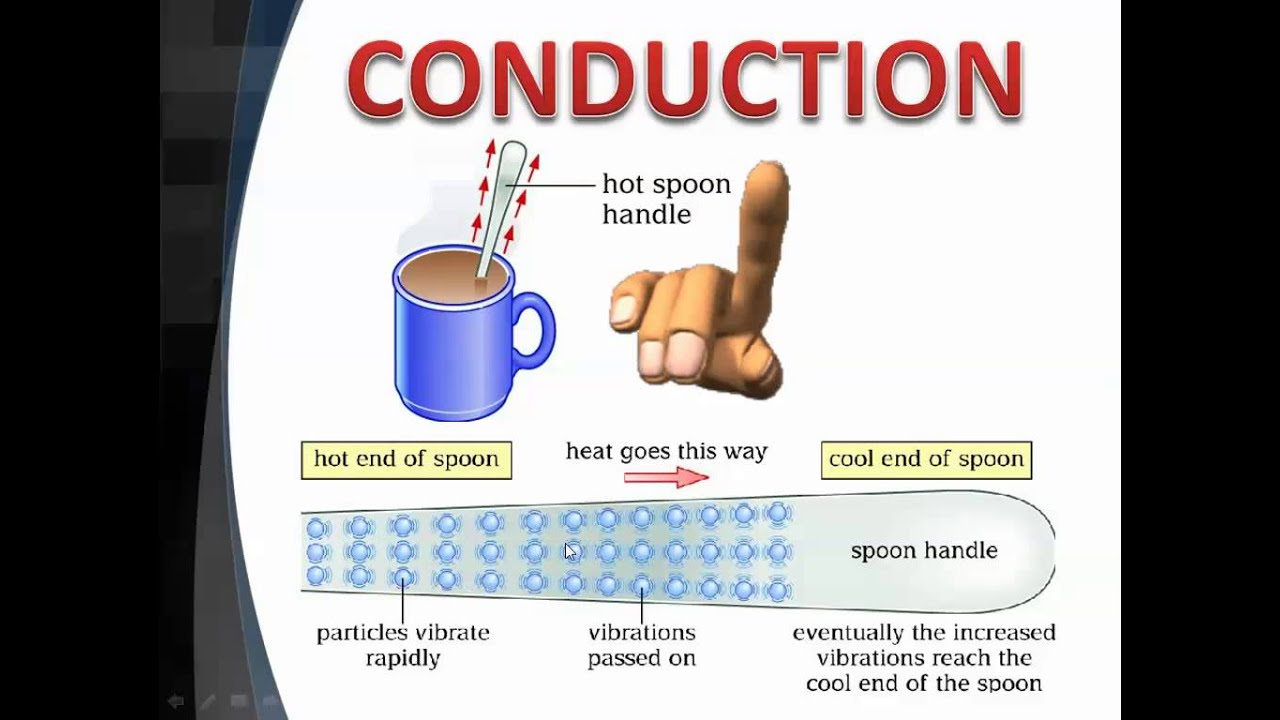
CONDUCTION
Thermal conduction is the transfer of heat (internal energy) by microscopic collisions of particles and movement of electrons within a body. The microscopically colliding objects, that include molecules, atoms, and electrons, transfer disorganized microscopic kinetic and potential energy, jointly known as internal energy. Conduction takes place in all phases of matter, including solids, liquids, gases and waves. The rate at which energy is conducted as heat between two bodies is a function of the temperature difference (temperature gradient) between the two bodies and the properties of the conductive medium through which the heat is transferred. Thermal conduction was originally called diffusion. Conduction: transfer of heat via direct contact. Heat spontaneously flows from a hotter to a colder body. For example, heat is conducted from the hotplate of an electric stove to the bottom of a saucepan in contact with it. In the absence of an external driving energy source to the contrary, within a body or between bodies, temperature differences decay over time, and thermal equilibrium is approached, temperature becoming more uniform.
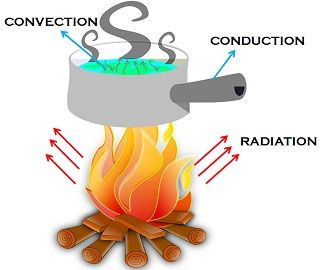
CONVECTION
Convection is the heat transfer due to bulk movement of molecules within fluids such as gases and liquids, including molten rock (rheid). Convection takes place through advection, diffusion or both. Thermal image of a just lit Ghillie kettle, note the plume of hot air resulting from the convection current. Convection cannot take place in most solids because neither bulk current flows nor significant diffusion of matter can take place. Diffusion of heat takes place in rigid solids, but that is called heat conduction. Convection, however, can take place in soft solids or mixtures where solid particles can move past each other. Thermal convection can be demonstrated by placing a heat source (e.g. a Bunsen burner) at the side of a glass full of a liquid, and observing the changes in temperature in the glass caused by the warmer ghost fluid circulating into cooler areas.

RADIATION
In physics, radiation is the emission or transmission of energy in the form of waves or particles through space or through a material medium.Radiation is often categorized as either ionizing or non-ionizing depending on the energy of the radiated particles. Ionizing radiation carries more than 10 eV, which is enough to ionize atoms and molecules, and break chemical bonds. This is an important distinction due to the large difference in harmfulness to living organisms. A common source of ionizing radiation is radioactive materials that emit α, β, or γ radiation, consisting of helium nuclei, electrons or positrons, and photons, respectively. Other sources include X-rays from medical radiography examinations and muons, mesons, positrons, neutrons and other particles that constitute the secondary cosmic rays that are produced after primary cosmic rays interact with Earth's atmosphere.

CONCLUSION
Heat transfer is a discipline of thermal engineering that concerns the generation, use, conversion, and exchange of thermal energy (heat) between physical systems. Heat transfer is classified into various mechanisms, such as thermal conduction, thermal convection, thermal radiation, and transfer of energy by phase changes. Engineers also consider the transfer of mass of differing chemical species, either cold or hot, to achieve heat transfer. While these mechanisms have distinct characteristics, they often occur simultaneously in the same system. Heat conduction, also called diffusion, is the direct microscopic exchange of kinetic energy of particles through the boundary between two systems. When an object is at a different temperature from another body or its surroundings, heat flows so that the body and the surroundings reach the same temperature, at which point they are in thermal equilibrium. Such spontaneous heat transfer always occurs from a region of high temperature to another region of lower temperature, as described by the second law of thermodynamics.
Comments
Post a Comment